 BarkBuddies

Natural dog treats have become something of a buzzword, and it is rarely clear what it actually means. Two bags can both call themselves natural even though one contains a single dried organ and the other a long list of additives, colourings and fillers. Here we go through what you should actually look for, why single protein matters, and how air-dried and freeze-dried treats differ in practice — with real numbers from our own range of dog treats.
What does "natural dog treats" actually mean?
There is no protected definition, so the term on its own says very little. What does say something is the ingredient list. A genuinely natural dog treat is characterised by the following:
- The ingredient list is short — often just a couple of words, such as "100% Swedish beef lung".
- The raw material comes from a single animal species and a single body part, with no blends.
- There is no sugar, grain, filler, colouring or preservative.
- The origin can be traced to a country, and preferably to a factory.
The rule of thumb is simple: the longer the ingredient list, the less natural the treat. Most of the treats in our range have an ingredient list that fits on one line, and a good share of them are also made from Swedish raw material.
Single protein — why it matters
Single protein, or monoprotein, means the treat contains protein from one animal species only. It sounds like a detail, but in practice it is the single most important property if your dog has a sensitive stomach or a suspected food allergy.
The reason is that you can only rule out what you control. If your dog reacts to a treat containing four kinds of meat, you have no idea which one caused it. With a pure single-protein treat you know exactly what your dog has eaten, which makes it possible to run an elimination trial systematically — and to keep rewarding your dog along the way without ruining the trial.
Single protein is practical for healthy dogs too. It makes it easy to vary protein sources over time and to avoid the very protein your dog's regular food already contains.
Air-dried single-protein treats: the full comparison
Air-dried treats are made by gently drying the raw material at low heat until the moisture is gone. What remains is a concentrate of meat or organ that keeps at room temperature and is usually crunchy or hard in texture.
Here are the air-dried single-protein treats in our range, sorted by fat content:
| Product | Raw material | Protein | Fat | Shape and texture |
|---|---|---|---|---|
| TassaFritt - Dried Blue Mussels | 100% blue mussels without shells | 81% | 2% | Approx. 1 cm, extremely low in fat |
| TassaFritt - Beef Kidney in Small Bites | 100% beef kidney | 83.6% | 6.1% | Pre-diced and mess-free |
| TassaFritt - Beef Heart in Small Pieces | 100% beef heart | 62.6% | 7.1% | Approx. 0.5x0.5 cm |
| Emmzo - Diced Lamb Liver | 100% Swedish lamb liver | 68.6% | 7.7% | 0.2–0.5 cm, hard and dry |
| Kerotugg - Beef Heart 100g | 100% Swedish beef heart | 83% | 8% | Approx. 2x2x0.5 cm |
| Kerotugg - Pork Heart 100g | 100% Swedish pig heart | 83% | 8% | Approx. 2.5x2.5 cm, crisp |
| Hugo & Celine - Dog Treats Moose Munchies | 100% Swedish minced moose | 72% | 9% | Breakable pieces |
| BarkBuddies - Bullchips Thin Pieces | 100% Swedish bull testicle | 85.2% | 9.3% | 2–5 cm wide, 0.3 cm thin |
| TassaFritt - Beef Liver Bites | 100% Swedish beef liver | 79.1% | 9.7% | Approx. 0.5x0.5 cm |
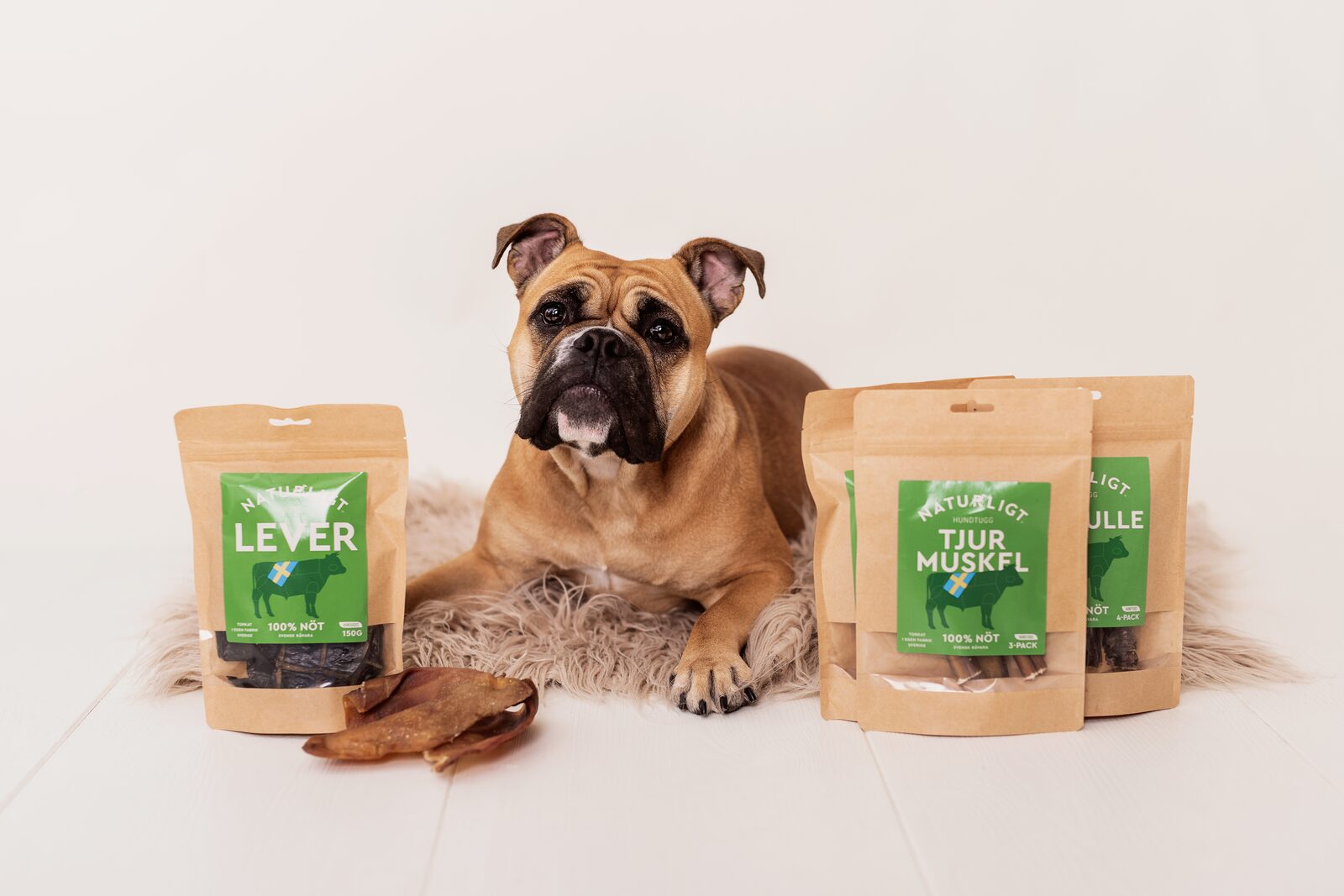
| Naturligt® - Beef lung thin pieces 50g | 100% Swedish beef lung | 50.6% | 13.7% | Porous and brittle, very easy to chew |
| Naturligt® - Beef Liver 150g | 100% beef liver | 60.6% | 13.7% | Pocket-friendly pieces |
| TassaFritt - Sprats | 100% sprat | 71% | 14% | 5–10 cm whole fish |
| Hugo & Celine - Dog Treats Crunchy Cookies | 100% Swedish beef tripe | 63.1% | 17.5% | Hard and crispy |
What jumps out immediately is how high the protein content sits. Several of the treats are above 80% protein, quite simply because there is nothing in the bag but dried meat or organ.
Freeze-dried — how is it different from air-dried?
Freeze-drying works differently. The raw material is frozen first and the water is then removed without applying heat. Because the process happens without heating, flavour compounds, vitamins and aroma are preserved in their original form, and the pieces keep their shape but turn airy and brittle.
In practice the difference shows up in three things: the smell is more intense, the pieces weigh almost nothing, and they can be broken apart with your fingers without resistance.
| Product | Raw material | Protein | Fat | Shape |
|---|---|---|---|---|
| Sund Hundmat - Freeze-Dried Arctic Prawns | 100% prawns from the North Atlantic | 68.7% | 4.5% | Whole prawns |
| Sund Hundmat - Freeze-Dried Beef Spleen | 100% beef spleen | 75.3% | 14.8% | Varying pieces |
| Sund Hundmat - Freeze-Dried Beef Heart | 100% beef heart | 73.1% | 20.3% | Varying pieces |
| Sund Hundmat - Freeze-Dried Sprat | 100% sprat | 55.6% | 29.9% | Whole fish |
| Monster - Freezies Chicken | 100% chicken meat | 44.2% | 41.9% | Approx. 1x1 cm |
| Monster - Freezies Pork | 100% pork | 48.1% | 42.7% | Approx. 1x1 cm |
| Monster - Freezies Lamb | 100% lamb meat | 45.3% | 45.2% | Approx. 1x1 cm |
| Monster - Freezies Beef | 100% beef | 46.4% | 45% | Approx. 1x1 cm |
Air-dried or freeze-dried — which should you choose?
This is where it is easy to draw the wrong conclusion. Freeze-dried is often presented as the more exclusive option, and it is tempting to assume it is therefore also leaner or healthier. The numbers say otherwise.
Compare the freeze-dried meat pieces from Monster, which sit between 41.9% and 45.2% fat, with air-dried beef heart at 8% or air-dried beef kidney at 6.1%. The difference is not small. At the same time, the leanest treat in the entire range — freeze-dried Arctic prawns at 4.5% fat — is itself freeze-dried.
The conclusion is that the drying method does not determine the fat content. The raw material does. A pure muscle meat with natural fat marbling ends up fatty no matter how it is dried, while lean organs such as heart, kidney and lung, or shellfish and mussels, stay lean.
So choose the method according to the property you are after:
- Air-dried gives a harder, crunchier piece that is chewed a little longer, holds its shape in your pocket and usually costs less per bag.
- Freeze-dried gives more intense smell and taste, extremely low weight, and pieces that can be broken down into very small rewards.
And always read the fat content on the specific product you are considering, rather than going by the method.
Fat, flavour and breakability
Fat content
For dogs that need to watch their weight, or that are sensitive to fat, it is worth staying in the lower part of the scale. TassaFritt's dried blue mussels at 2% fat, Sund Hundmat's freeze-dried Arctic prawns at 4.5% and TassaFritt's dried beef kidney at 6.1% are the leanest options we have.
Liver is one exception worth mentioning separately. It is very nutrient-dense and contains vitamin A among other things, so liver-based treats should be given in moderation as part of a balanced diet rather than in large amounts.
Flavour
The strength of the flavour varies more between raw materials than you might think. Pig heart is described as somewhat more flavourful than beef heart, which makes it a good choice when you need extra motivation. Game such as moose has a deeper aroma that often makes fussy dogs take notice, and fish and shellfish have a strong smell that works well when concentration is running low. If your dog is extra picky, it can be worth trying fish and shellfish treats or lamb before you give up.
Breakability
How easily a treat breaks decides how useful it is in training, and the products differ considerably here:
- Ready to use straight away: Emmzo - Diced Lamb Liver (0.2–0.5 cm) and TassaFritt - Beef Liver Bites (approx. 0.5x0.5 cm) are already reward-sized.
- Very easy to break: The freeze-dried pieces of approx. 1x1 cm from Monster can be broken down further with your fingers.
- Break down before the session: Kerotugg - Beef Heart 100g and Pork Heart 100g come in pieces of approx. 2–2.5 cm that you easily size yourself.
- Whole natural products: TassaFritt - Sprats are 5–10 cm whole fish and work best as a reward in themselves, not as a training treat.
Another practical measure is how messy the treat is. Air-dried mini pieces of heart, kidney and liver are consistently described as completely mess-free, which in practice means they can sit in your pocket for the whole walk.
Treats that are not single protein
Not every good treat is monoprotein, and that does not have to be a problem as long as you know about it. A few examples from the range:
| Product | Contents | Protein | Fat |
|---|---|---|---|
| Kerotugg - Dog Treats Deer & Wild Boar 80g | 50% deer and 50% wild boar | 45% | 22% |
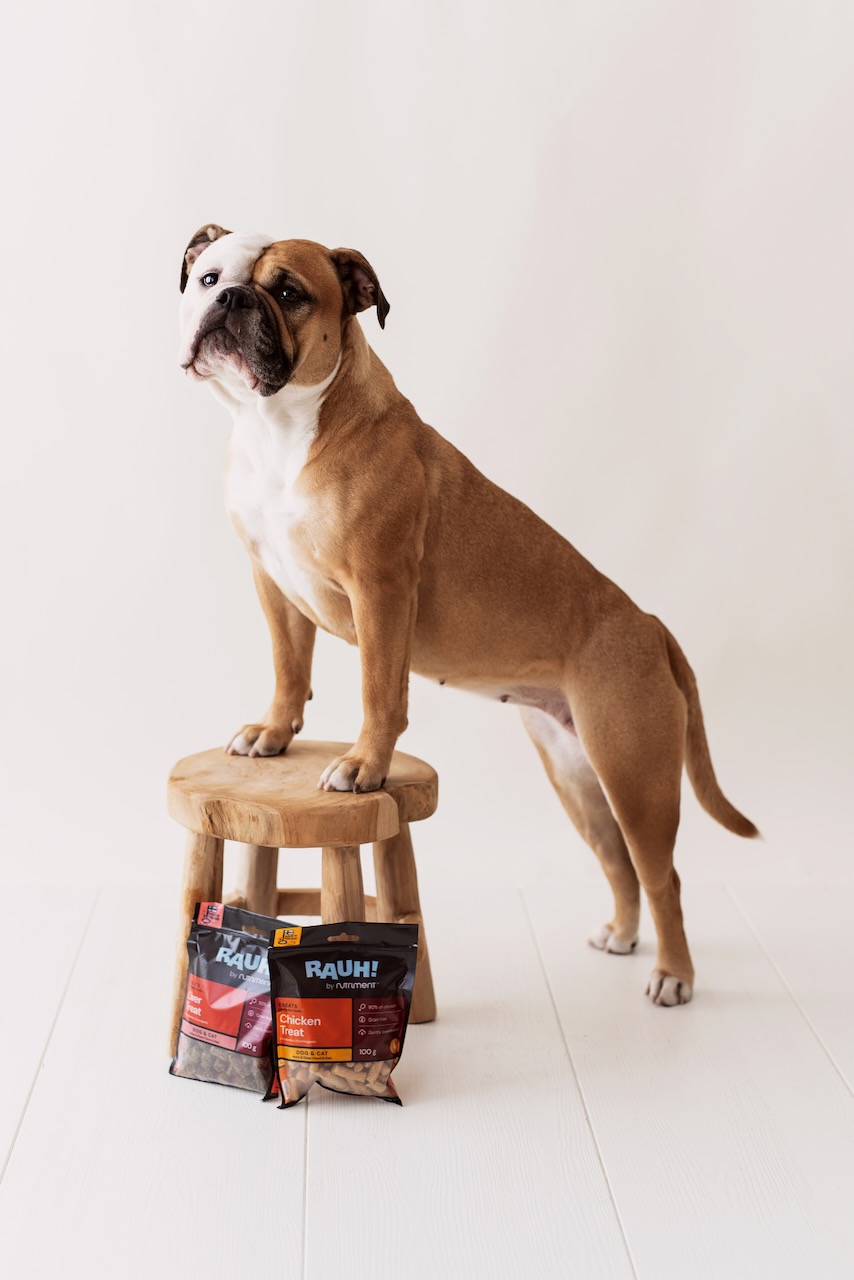
| RAUH! by Nutriment - Dog Treats Salmon | 94% salmon meat and plant fibre | 30% | 42% |
| RAUH! by Nutriment - Turkey Dog Treats | 90% Finnish turkey | 30.8% | 42.2% |
| RAUH! by Nutriment - Dog Treats Chicken | 90% Finnish chicken meat | 31.8% | 33.5% |
The oven-baked pieces from RAUH! by Nutriment are grain-free and free from colourings and preservatives, but contain plant fibre in addition to the meat. The game treat from Kerotugg mixes two kinds of meat in the same bag. Both are excellent rewards — they are simply not the right tool if you are running an elimination trial.
How to choose in practice
Start with what the treat is for. If you train a lot you need something small, mess-free and lean that your dog can have many times over without blowing the daily allowance — diced liver, mini pieces of heart or freeze-dried cubes work well. If the treat is meant to be a reward or a special moment, you can go up in size and flavour strength.
Remember that treats count towards your dog's total daily intake. An air-dried treat is a concentrate with the water removed, so a small piece contains more energy than it looks like it does. A common rule of thumb is that treats should make up no more than about a tenth of the daily intake, and that you deduct the equivalent from the meal portion during intensive training periods.
Do vary the protein sources over time. It keeps interest up and makes it easier to find out what your dog actually tolerates if problems should appear. If you want to complement treats with something that lasts longer, you will find our advice in the guide on how to choose the best chew bone.
Common questions about natural dog treats
What counts as a natural dog treat?
A treat where the ingredient list consists of the raw material and nothing else — no sugar, grain, filler, colouring or preservative. In practice that means air-dried or freeze-dried meat, organ or fish, preferably with a clearly stated origin.
Are freeze-dried treats healthier than air-dried?
Not automatically. Freeze-drying happens without heat and preserves aroma and nutrients well, but the fat content is governed by the raw material, not by the method. Freeze-dried muscle meat can be above 40% fat while air-dried beef heart sits around 8%.
Which natural dog treat suits a sensitive stomach?
A pure single-protein treat, so that you know exactly what your dog has eaten. Lean organs such as heart and kidney are often gentle, and lamb is described as a milder protein that suits dogs reacting to more common kinds of meat.
Which treat is the leanest?
TassaFritt's dried blue mussels at 2% fat, followed by Sund Hundmat's freeze-dried Arctic prawns at 4.5% and TassaFritt's dried beef kidney at 6.1%.
Is Naturligt® the same thing as natural dog treats?
No. Naturligt® is one of the brands we sell — the name is simply the Swedish word for "naturally" — while natural dog treats is a description that applies to many of our brands. Several manufacturers in the range make completely natural treats without additives.
How many treats can my dog have per day?
It depends on your dog's size and activity level, but a common rule of thumb is that treats should not exceed about a tenth of the daily intake. Since air-dried treats are a concentrate, small pieces go a long way.
If you want to start browsing, you will find our whole range of natural dog treats here, and you can filter directly on crunchy treats or beef treats if you already know what you are looking for.